Most flippers don't lose money on the house. They lose it before demo even starts.
The investor's playbook for a full interior flip — run on schedule, finished in 99 days.
Digital download. Instant access. Refund if it doesn't deliver.

Is this guide for you?
This is for you if…
- You want to buy, rehab, and sell a house for profit — and you're doing it for the first time.
- You have access to capital, but not necessarily construction experience.
- You understand that real estate investing is a business, not a hobby.
- You're willing to act as the project manager — on-site, decisive, and in charge.
- You want a repeatable process, not a one-time lucky break.
This is NOT for you if…
- You're planning to do the construction yourself to save money on labor.
- You want a passive investment that runs without your attention.
- You're looking for general real estate advice — this is specifically about the rehab phase.
- You already have 10+ flips under your belt and a system that works.
The same three breakdowns kill flip after flip.
Every failed or underperforming flip traces back to bad numbers, bad contractors, or bad timing. Usually all three.
Bad Numbers
- You overpay at acquisition because the ARV math was wrong.
- You didn't run the numbers before you made the offer.
- Small cost overruns compound into a margin you can't recover.
- You mixed tiers — a Showcase kitchen in an Investor Grade neighborhood.
Bad Contractors
- A contractor takes your deposit and goes dark.
- Work drags on for weeks with the crew nowhere in sight.
- Substandard work gets covered up before you can catch it.
- A lien gets filed against your property and stalls the sale.
Bad Timing
- Holding costs eat the profit while the schedule slips.
- Materials get ordered late and become the critical path.
- Slow decisions leave contractors waiting — with your money.
- The house sits on market too long because it was priced wrong.
New to flipping? See the five mistakes that sink most first flips — free.
Get the Free Guide →
The right work. The right order. The right crew. 99 days.
This is not a guide for the owner-operator who plans to swing a hammer himself. It's written for the investor who acts as project manager — present on site, making decisions, moving the schedule, and managing contractors with the precision of a general contractor who knows what questions to ask, even without construction experience.
You don't need to know how to hang drywall. You need to know when it should be hung, who should hang it, and what to look for when they're done.
Carrying costs on a vacant property — insurance, taxes, utilities, and loan interest — add up every single day. Every day the house sits unsold is a day your margin erodes. Urgency isn't just a mindset. It's math.
Exactly what you'll take away from this guide.
Specific, tactical, and immediately applicable to your first flip.
Every decision runs through three tiers.
Your tier isn't a preference. It's a math problem — determined by your market, your ARV, and the buyer you're building for. Choosing the wrong tier is the most common way first-time flippers overspend past their margin.
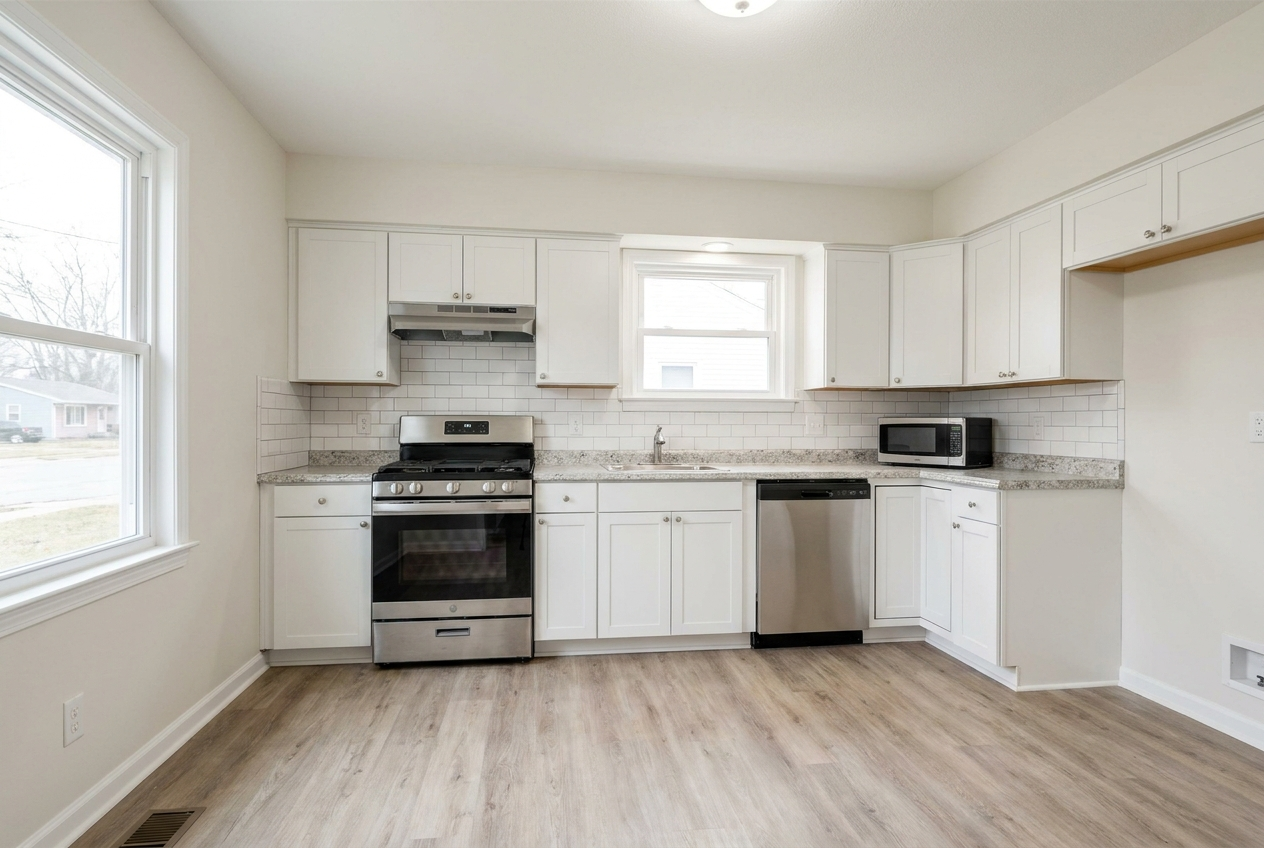
Clean. Functional. Neutral.
Attracts buyers looking for a solid home at a fair price. Nothing wrong — nothing fancy.
- Stock cabinets, laminate counter
- Clean tile, basic vanity
- LVP flooring throughout
- Mowed, mulched landscaping

Updated. Modern. Tasteful.
The most forgiving tier for first-time flippers. Competitive in the mid-range of most markets.
- Semi-custom cabinets, quartz counter
- Updated tile, solid vanity top
- LVP or engineered hardwood
- Planted beds, fresh sod patches

High-end. Designer-influenced.
Targets buyers who want the best in the neighborhood — and will pay a premium for it.
- Custom cabinets, waterfall quartz
- Full tile surround, framed vanity
- Hardwood or premium tile
- Full landscape design with hardscape
"Buyers feel the mismatch even when they can't articulate why." A Showcase kitchen in an Investor Grade neighborhood doesn't appraise — and you can't recover that overspend at the closing table.
The playbook, from offer to closing table.
Each chapter covers a specific phase, tied to calendar days. Read it once before Day 1. Then use it as a reference while the project moves.
The 99-Day Flip: Why Speed Is a Financial Discipline
Every day the house sits unsold, your margin erodes. This chapter establishes the investor-as-PM mindset — and why urgency is a financial strategy, not a personality trait.
ARV, Acquisition Math, and Choosing Your Tier
The most important decisions happen before a single permit is pulled. The numbers you establish here govern every decision for the next 99 days. Get them wrong and no amount of hard work recovers the margin.
The Deal and the Plan: Lock Everything Before a Wall Comes Down
The GC walk, the Scope of Work, material ordering, and contractor payment milestones. The first seven days are coordination days, not construction days — the decisions made here determine how cleanly the next 92 go.
Demo and Rough Systems: Open the Walls. Update the Bones.
Demo follows a sequence that protects the work ahead. Once complete, the rough-in trades go in — plumbing, electrical, HVAC. The most invisible phase to buyers, and the most critical to the property's long-term function.
Drywall and Exterior: Two Tracks Running at Once
Drywall crews work inside while exterior crews work outside simultaneously. Curb appeal drives showings. Showings drive offers. The cure schedule, exterior finish levels by tier, siding, roof, and landscaping timing are covered here.
Interior Finishes: This Is What Buyers See. No Shortcuts.
The property transforms from construction site to home. Paint, flooring, kitchen, bathrooms, trim, and hardware — in the right sequence. A kitchen and two bathrooms account for more than half of buyer perception. Spend and hold back in the right places.
The Final Sprint: Punch List, Staging, Listing, and Offers
Construction is done. Now you sell it. The punch list walkthrough, professional clean, staging strategy, and the listing approach — including why you list on Thursday and set a Sunday offer deadline — that generates competing offers instead of a slow market.
What Kills Flips: Five Failure Modes, All Preventable
Scope creep. Contractor failure. Material delays. Budget bleed. Timeline paralysis. Every failed flip traces back to one of these five. This chapter shows you exactly how to see them coming — and what to do when they arrive.
Still deciding? Get the free What Kills Flips guide before you risk a dollar.
Send Me the Free Guide →What kills flips — and how to stop them.
"Every failed or underperforming flip can be traced to a breakdown in one of five areas. None of them are surprising. All of them are preventable — if you know what to look for."
Scope Creep
The project that grows after you start. Small "while we're in the wall" decisions compound into overruns that were invisible when you underwrote the deal. A tight Scope of Work and a strict change-order process are the only defense.
Contractor Failure
The biggest single timeline risk in any flip. Mitigation is front-loaded: vet before hiring, use written contracts with milestones, and structure payments to preserve your leverage through completion.
Material Delays
Cabinets are the most common cause. Six-to-ten-week lead times mean cabinets ordered late become the critical path that holds up countertops, trim, and final inspection. Order long-lead materials in week one.
Budget Bleed
A flip rarely fails from one large mistake. It fails from twenty small overruns. Carry a 10–15% contingency, track every expense weekly, and apply the same discipline you applied to acquisition math.
Timeline Paralysis
The cost of slow decisions. Each unmade decision is a contractor waiting on you — with billable time accumulating. When a contractor asks a question, he needs an answer within the hour.
If it doesn't deliver, you pay nothing.
Read the full guide. If you don't come away with a clearer acquisition framework, a working understanding of the 99-day process, and at least three things you would have done differently on your first flip — email us. We'll refund every dollar, no questions asked.
Get the Book — $27 →Digital download. Instant access. Full refund available.

Get the complete field guide.
The 99-Day Rehab: the investor's playbook to run a full interior flip on schedule — the chapter-by-chapter sequence behind everything above.
Digital download. Instant access. Full refund if it doesn't deliver.
Before you buy.
No. The guide is written for the investor who acts as project manager — not the one swinging the hammer. You'll learn when each phase of work should happen, who should do it, and what to inspect when it's done. The skill it builds is decision-making and contractor management, not carpentry.
It's aggressive but achievable for a standard interior rehab with no new construction — when you line up contractors and order long-lead materials before Day 1. The entire book is built around that sequence, which is exactly why the pre-permit and first-week chapters come before any demo.
No. It's specifically about rehabbing the interior and landscaping of an existing house — no footprint changes, no additions, no new square footage. That focus is what makes the 99-day timeline possible.
It's a digital download. You get instant access the moment you purchase, and you can read it on any device. No physical shipment, no waiting.
The three-tier framework — Investor Grade, Market Ready, Showcase — is designed to adapt to any market. You choose the tier based on your ARV and your neighborhood, so the same process scales from a starter-home flip to a higher-end one. Results vary by market, property condition, and investor experience.
Email us and we'll refund every dollar, no questions asked. If the guide doesn't give you a clearer acquisition framework and a working understanding of the 99-day process, you shouldn't pay for it.
Start with the free guide: What Kills Flips.
Enter your email and we'll send it right now. No pitch, no pressure — just the framework.
- The five failure modes behind almost every failed flip.
- Six warning signs a contractor is about to be a problem.
- The long-lead materials list — order in week one.
- The weekly budget review that protects your margin.